Michael E. Hattaway (Retired)
IRON BROTHERHOOD
The Complete Journey to Strength, Accountability, and Character
Second Edition. Revised and Expanded.
Michael E. Hattaway (Retired)
Iron Strengthens Iron
Copyright
Iron Brotherhood: The Complete Journey to Strength, Accountability, and Character
© 2026 Michael E. Hattaway (Retired). Iron Strengthens Iron. All Rights Reserved.
No part of this book may be reproduced in any form or by any electronic or mechanical means, including information storage and retrieval systems, without written permission from the author, except for the use of brief quotations in a book review.
This book offers educational frameworks for personal growth, brotherhood, and character formation. It is not a substitute for professional mental health care. If you are working through significant distress, discuss these educational frameworks with your licensed treating clinician. If you are in crisis, call or text 988, the Suicide and Crisis Lifeline. Veterans: dial 988, then press 1.
The first edition of this book was published in 2024. This second edition has been rebuilt on the Stoic foundation that now anchors the Iron Strengthens Iron brotherhood, and is designed as the companion volume to The Stoics' A.L.I.V.E. Code.
Second Edition
Epigraph
"Men exist for the sake of one another."
Marcus Aurelius, Meditations
A Note on Faith
Iron Strengthens Iron is a Stoic-first brotherhood. The main text of this book stands on philosophy, evidence, and practice. It asks nothing of you except honesty and work.
Many men in this brotherhood also carry a living faith. That faith is welcome here. It is honored here. It is not required here.
Throughout this book you will find short sections marked [Religionized] For Men of Faith. These sections carry forward the scriptural foundations of the first edition for the men who want them. If faith is part of your formation, read them and put them to work. If it is not, pass over them without apology. The chapter stands complete without them, and so do you.
One brotherhood. One standard. Two doors into the same room.
Introduction: Why Brotherhood, Why Now
You were not built to do this alone. That is not a slogan. It is an observable fact about men, confirmed by every generation that came before you and by the quiet difficulty of your own life right now.
Look around honestly. Men today have hundreds of contacts and no confidants. They have followers and no brothers. They can reach anyone on earth in seconds and have no one to call at two in the morning when the weight gets real. Researchers call it an epidemic of male loneliness. The Stoics would have called it something simpler: a man cut off from the common good, trying to be a citadel with no city around it.
Two thousand years ago, Marcus Aurelius ruled the most powerful empire in the world. He commanded armies. He could have anything he wanted. And in his private journal, the book we now call Meditations, the entry that repeats more than almost any other is this: men exist for the sake of one another. The strongest man of his age reminded himself daily that strength is not a solo project.
That is the argument of this book. Iron left alone does not strengthen. Iron left alone rusts. It is contact, friction, pressure, and heat that turn raw metal into something that holds an edge. The same is true of men. As iron strengthens iron, one man strengthens another.
What this book is. This is a field manual for building, joining, and sustaining a brotherhood of men committed to strength, accountability, and character. It walks the complete journey: the call to brotherhood, the foundations beneath it, the resilience it builds, the accountability that powers it, the mentorship that extends it, and the legacy it leaves. It ends with a covenant, because a brotherhood without a stated standard is just a group of men who happen to know each other.
What this book is not. It is not motivation. Motivation is weather. It arrives, it leaves, and it owes you nothing. This book is climate work: the slow, deliberate construction of an environment in which you cannot help but grow, because the men around you refuse to let you shrink.
The framework underneath. This book is the brotherhood companion to The Stoics' A.L.I.V.E. Code, the Iron Strengthens Iron formation manual. The Code gives a man five pillars for his own formation: Awareness, Liberation, Integrity, Vitality, and Endurance. This book takes those same five pillars and asks the next question: what happens when men practice them together? You do not need to have read the Code first. Everything you need is explained here. But the two books are built to work as a pair: one forms the man, the other forges the men.
How to use this book. Read it with a pen. Every chapter ends with action steps and reflection prompts. Do them. A chapter you read and do not practice is a chapter you have not actually read. If you lead a group, the appendices give you a covenant template, a thirty-day challenge, a resilience toolkit, and a full set of group activities. If you are alone right now, start anyway. Chapter 1 will show you how to find your men.
The journey starts on the next page. Bring your honesty. The brotherhood will supply the rest.
Chapter 1: The Call to Brotherhood
"Associate with those who will make a better man of you."
Seneca, Letters
The Need for Brotherhood in Modern Life
In an era marked by isolation and disconnection, brotherhood is not a luxury for men. It is a vital necessity.
The numbers tell part of the story. Men report fewer close friendships today than at any point on record. The number of men who say they have no close friends at all has multiplied several times over in a single generation. But you do not need a survey to know this. You can feel it. The friendships that came easily at twenty thin out at thirty and vanish by forty-five. Work expands. Family demands what it rightly demands. And one day a man looks up and realizes that everyone who truly knows him either lives in his house or lives in his past.
The pressures of contemporary life land hard on men who carry them alone. Responsibilities at work, expectations at home, and the steady demand to appear fine produce a particular kind of exhaustion: the exhaustion of performing strength instead of building it. In those moments, the presence of brothers changes everything. Shared struggle cuts the weight of struggle. A man who knows his battles are witnessed fights differently than a man who believes no one is watching.
The Stoics understood this long before the research caught up. Marcus Aurelius wrote that what injures the hive injures the bee: no man flourishes while cut off from the community that forms him. Epictetus taught in a circle of students, not a lecture hall of strangers. Seneca poured his philosophy into letters to a friend, because he knew that wisdom that is not shared hardens into vanity. The men we now call the great individualists of antiquity were nothing of the sort. They were men formed in brotherhood, sharpened by correspondence, accountability, and shared practice.
Brotherhood transcends camaraderie. Camaraderie is enjoying the same room. Brotherhood is a bond with a standard in it: a commitment to uplift one another through trial, to tell one another the truth, and to refuse to let a brother quietly become less than he is capable of being.
The Stoic Foundation of Brotherhood
Brotherhood is not a modern invention and not a sentimental one. It rests on three claims the Stoics made about the nature of men, and each one is load-bearing.
First: men are made for one another. The Stoics taught that human beings are social by design, the way bees are made for the hive and hands are made to grasp. A man who isolates is not being strong. He is malfunctioning. Marcus put it bluntly: to cut yourself off from other men is to cut a limb from the body. The work of this book begins with accepting that claim, because every practice in it follows from that premise.
Second: character is formed by contact. No man develops courage in a vacuum, honesty with no one to be honest to, or loyalty with nothing to be loyal to. The virtues are social skills before they are private possessions. The brotherhood is the gymnasium in which they are trained. This is why the motto of this community is not "iron strengthens itself." It is: as iron strengthens iron, one man strengthens another.
Third: the measure of a man's circle is the man it produces. Seneca told his friend Lucilius to associate with those who would make a better man of him, and to welcome those whom he could improve. The instruction cuts both ways. Your brotherhood must sharpen you, and you must arrive as a whetstone, not just a blade. Membership is a contribution, never merely a benefit.
Take these three claims seriously and the call to brotherhood stops being an invitation to a social club. It becomes a duty you owe to your own formation and to the formation of other men.
The Benefits of Brotherhood
Be practical about what brotherhood actually delivers, because the cost of building one is real and the return must justify it.
Perspective. Alone, a man's problems echo and amplify. In a circle of brothers, problems shrink to their true size. The brother who walked through divorce can tell you what the first year actually holds. The brother who rebuilt after a business failure can show you the difference between a setback and a sentence. Brotherhood is borrowed experience, and borrowed experience is the cheapest wisdom a man will ever acquire.
Accountability. A goal kept private is a goal kept optional. The moment you speak a commitment to men who will ask about it next week, the commitment changes weight. Chapter 5 builds this machinery in detail. Here it is enough to say: men who answer to other men do what men who answer only to themselves merely intend.
Resilience. Adversity met alone depletes. Adversity met in company trains. A brotherhood does not remove the load from a man's back. It spots the lift. The difference between crushing weight and training weight is often nothing more than the men standing beside the bar.
Honest mirrors. Every man has blind spots, and by definition he cannot see them. A brotherhood that has earned the right through trust will tell a man the truth about himself before the consequences do. That single function, the honest mirror, justifies every hour brotherhood costs.
Steadiness under loss. Sooner or later, life takes something from every man: a career, a marriage, health, a person he could not live without. The man embedded in a brotherhood grieves with witnesses and rebuilds with help. The isolated man does both alone, and many never finish.
Responding to the Call
A call that receives no answer changes nothing. Hearing the case for brotherhood and filing it away for later is the precise pattern this book exists to break.
Responding to the call looks different depending on where you stand. The man with old friendships gone quiet responds by reactivating them: one call, one invitation, one honest conversation that goes a layer deeper than the usual exchange. The man in a men's group that has gone soft responds by raising its standard, using the tools in Chapters 5 and 8. The man starting from zero responds by identifying two or three men he respects and extending a direct invitation. Appendix G gives you the exact playbook.
Notice what every version has in common: initiative. Brotherhood never arrives by drift. Drift only carries men apart. Someone must move first, say the unguarded thing first, and risk the awkwardness of inviting other men into something with a purpose. In your circle, let that someone be you.
One warning before you begin. Do not wait until you are ready. You will never feel ready to need other men. Readiness is not a prerequisite for brotherhood. It is a product of it.
Action Steps
Write down the names of every man you could call at two in the morning. If the list is shorter than three, you have found your first project. Keep the list. You will use it in Chapter 2.
Contact one man this week. Not a text reaction. A call or a face-to-face invitation, with one honest sentence about why: "I am building something with a few men I respect, and you are on the list."
Read the motto aloud: as iron strengthens iron, one man strengthens another. Then write one sentence describing what you bring to a brotherhood, not what you want from one.
Reflection Prompts
When did you last have a friendship with a standard in it: one where a man could challenge you and the friendship got stronger? What made that possible?
Which costs you more right now: the weight you are carrying, or the fact that you are carrying it alone?
What has isolation quietly taken from you in the last five years that you have not yet named?
[Religionized] For Men of Faith
The call to brotherhood that this chapter grounds in Stoic philosophy is also the oldest pattern in Scripture. "It is not good that the man should be alone" (Genesis 2:18) is the first negative judgment in the Bible, spoken before any fall. Ecclesiastes 4:9-12 makes the practical case: two are better than one, for if either falls, his companion can lift him up, and a cord of three strands is not quickly broken. And Proverbs 27:17 gives this brotherhood its name: "As iron sharpens iron, so one man sharpens another." If you walk by faith, hear the call in stereo: philosophy and Scripture, reason and revelation, both pointing to the same door. Walk through it with prayer, and bring another man with you.
Chapter 2: Foundations of Brotherhood
"First say to yourself what you would be; and then do what you have to do."
Epictetus, Discourses
Core Values That Unite a Brotherhood
A brotherhood is not held together by affection. Affection is the warmth of the bond. Values are its structure. Groups built on warmth alone dissolve at the first real test, because warmth gives men nothing to hold each other to. Groups built on shared values survive conflict, distance, and time, because the standard remains when the feeling fluctuates.
Iron Strengthens Iron stands on four values. Name them at your first meeting and return to them at every crossroad.
Accountability. Own your actions, your growth, and your failures without excuse. In this brotherhood, blame is noise and ownership is signal. A man who cannot say "that was mine" cannot be strengthened, because he has not yet located the part of his life he controls.
Brotherhood. Build relationships strong enough to carry weight: shared adversity, honest speech, reliable presence. Brotherhood here is a discipline, not a feeling. You show up when it is inconvenient. You tell the truth when it is uncomfortable. You stay when it would be easier to drift.
Stoic resilience. Train the inner life. Master what is in your control, release what is not, and meet adversity as material for formation rather than evidence of unfairness. Chapters 3 and 4 build this capacity in depth.
Character formation. Pursue virtue, discipline, and integrity as the foundation of a life well lived. Everything else this brotherhood does, every meeting, every challenge, every covenant, is scaffolding around this single construction project: the man you are becoming.
The A.L.I.V.E. Code: The Operating System
Values tell a brotherhood what it honors. A framework tells it what to do on Tuesday. The operational framework of Iron Strengthens Iron is the A.L.I.V.E. Code, presented in full in this book's companion volume, The Stoics' A.L.I.V.E. Code. Here is the working summary every brother should know.
A. Awareness: see yourself honestly. The unexamined pattern repeats itself at your expense. Awareness is the discipline of honest self-observation: knowing your triggers, your defaults, and the gap between who you say you are and how you actually behave. In brotherhood, awareness is doubled, because your brothers see what you cannot.
L. Liberation: release what does not serve you. Every man carries weight that is not his to carry: old resentments, borrowed expectations, habits that pay him nothing. Liberation is the deliberate setting down of that weight. In brotherhood, liberation accelerates, because naming a weight aloud to men you trust breaks half its grip.
I. Integrity: align your actions with your values. Integrity is the distance between your stated standard and your actual conduct, driven toward zero. In brotherhood, integrity becomes measurable, because your commitments are witnessed and your follow-through is checked.
V. Vitality: invest in body, mind, and spirit. A man's energy is the fuel for everything else he intends. Vitality is the maintenance schedule: training, sleep, learning, stillness. In brotherhood, vitality is contagious. Standards of health travel through a group faster than any lecture.
E. Endurance: hold the line. The formed man is tested most by time. Endurance is staying steady through hardship, holding your ground when motivation is gone, and treating every obstacle as the path. The long game is won by the man who does not quit. Brotherhood is both the training ground for endurance and what makes it possible: the men beside you keep you in the fight when your own will flags.
Five pillars. One direction. When this book refers to the Code, this is the machinery it means.
Creating a Vision for Brotherhood
A brotherhood without a vision defaults to becoming a hangout, and a hangout cannot hold men through hard seasons. Vision is the answer to a simple question: what are we building together, and what kind of men must we become to build it?
Set the vision early and set it in writing. A strong brotherhood vision has three layers.
The man. What does this group expect each member to become? Stronger in body, steadier in adversity, more honest in speech, more present at home. Name it. A vision that cannot name the man it produces is decoration.
The bond. What kind of relationships will this group maintain? Confidentiality without exception. Honesty over comfort. Presence at each other's critical moments. Decide now, before the first test arrives, because the first test does not announce itself.
The reach. What does this group give beyond itself? A brotherhood that exists only for its members eventually turns stale. Service, mentorship, and visible example are not extras. They are the exhaust of a healthy engine. Chapters 7 and 9 expand this layer.
Write the three layers in plain sentences. You will formalize them in the covenant in Chapter 12. For now, draft. A rough vision on paper outworks a perfect vision in the air.
Action Steps
With your group, or in draft if you are still alone, write the four values in your own words: one sentence each for accountability, brotherhood, Stoic resilience, and character formation.
Draft your three-layer vision: the man, the bond, the reach. Hold it loosely; the covenant process in Chapter 12 will refine it.
Choose one shared practice from this chapter and schedule its first occurrence within seven days. A practice without a date is a preference.
Reflection Prompts
Which of the four values do you currently live most convincingly? Which one would the people closest to you say is weakest in you?
Of the five A.L.I.V.E. pillars, which one, if you strengthened it this year, would most change the trajectory of your life?
What practice have you always intended to maintain alone and never sustained? What does that tell you about how you are built?
[Religionized] For Men of Faith
The early church gives the pattern this chapter translates: "They devoted themselves to the apostles' teaching and to fellowship, to the breaking of bread and to prayer" (Acts 2:42). Note the architecture: shared doctrine, shared table, shared practice. For men of faith, the shared disciplines of your brotherhood can and should include prayer for one another by name, and time in the Word together. Hebrews 10:24-25 is the standing order: consider how to spur one another on toward love and good deeds, and do not give up meeting together. Let your vision name Christ at the center, and let your practices make that naming real rather than rhetorical.
Chapter 3: Strength Through Resilience
"The impediment to action advances action. What stands in the way becomes the way."
Marcus Aurelius, Meditations
The Dichotomy of Control
Every Stoic practice, and most of this brotherhood's strength, descends from one distinction. Epictetus opens his entire teaching with it: some things are within our power, and some things are not.
Within your power: your judgments, your choices, your effort, your character, your response. Outside your power: outcomes, other people's opinions and decisions, the economy, the diagnosis, the past, and most of the future. Resilience begins the moment a man stops spending strength on the second category and concentrates it entirely on the first.
Watch what this does under real pressure. A man loses his job. The loss itself sits outside his control; no amount of replaying changes it. What remains inside his control is substantial: the discipline of his search, the condition of his body during the season, the honesty with which he faces his family, the story he tells himself about what this means. The untrained man pours his energy into the uncontrollable and arrives at the controllable already exhausted. The trained man makes the cut quickly, grieves what is gone, and goes to work on what remains.
This is the first skill to train in your brotherhood, because it multiplies in company. When a brother brings a crisis to the circle, the circle's first question becomes: which parts of this are yours to control? Half of resilience is a sorting operation, and brothers sort faster than solitary men.
Learning from Trials
The Stoics made a claim that sounds outrageous until you test it: adversity is not the interruption of formation. It is the means of it.
Seneca said that difficulties strengthen the mind as labor strengthens the body, and he meant it mechanically, not poetically. Courage cannot exist in a man who has never faced fear. Patience cannot develop without delay. Loyalty is theoretical until it costs something. Every virtue is forged exclusively in conditions that demand it. A life without trials would not be a blessed life. It would be an unformed one.
Marcus gave the principle its sharpest form: what stands in the way becomes the way. The obstacle is not blocking the path of formation. The obstacle is the path. The failed venture trains judgment. The strained marriage trains humility and repair. The injury trains patience and adaptation. None of this makes hardship pleasant, and Stoicism never asks you to pretend it does. It asks something harder and more useful: to treat every trial as raw material and to refuse to waste your suffering.
Brotherhood transforms this from philosophy into procedure. When a brother is inside a trial, the circle holds the frame he cannot hold alone: this is material, you will build with this, and we will not let you waste it. And when the trial passes, the circle conducts the review: what did this season teach, what did it expose, what capacity did it build? Pain plus reflection becomes wisdom. Pain without reflection is just pain.
Developing a Resilient Mindset
Resilience is not a temperament some men are issued at birth. It is a trainable capacity, and the training methods are old, tested, and available to any man willing to practice. Four belong in every brotherhood.
The morning preview. Before the day begins, rehearse it honestly: today I will meet friction, delay, rudeness, and at least one thing going sideways. This is not pessimism. It is inoculation. The man who has rehearsed difficulty meets it as expected weather. The man who expected smoothness meets the same difficulty as an outrage and loses his footing.
The evening review. Seneca examined his day each night before sleep: where did I do well, where did I fail, what will I do differently tomorrow. Ten minutes, three questions, written down. Done daily, this single practice compounds into self-knowledge faster than any seminar. Done in a brotherhood, with men comparing reviews weekly, it compounds faster still.
Voluntary discomfort. Train hardship on your own schedule so that involuntary hardship finds you conditioned. Cold mornings, hard training, fasting, time without comfort. The Stoics practiced poverty days not because deprivation is noble but because tested men do not panic. A brotherhood that shares voluntary discomfort builds, in advance, the muscle it will need on the day discomfort is not voluntary.
The longer view. Marcus governed through plague, war, and betrayal by repeatedly zooming out: this moment is one frame in a long film. Most of what feels unbearable today will be a sentence in the story you tell in ten years. Perspective does not shrink real loss, but it right-sizes nearly everything else.
Resilience Is a Team Sport
Everything above can be practiced alone, and the solitary man who practices it will improve. But the research on human endurance and the experience of every hard profession agree: the strongest predictor of a man's resilience is not his private toughness. It is the quality of the men around him.
This is not a weakness in the design. It is the design. Soldiers endure for the man beside them. Crews survive for each other. The brotherhood is not a comfort station attached to your formation. It is a structural component of your strength. A man who knows his brothers will catch him takes the bolder, truer line through difficulty. A man with no one beneath him plays small and calls it prudence.
So build the structure before you need it. The worst time to assemble a rope team is mid-fall.
Action Steps
Take your current heaviest problem and divide a page into two columns: inside my control, outside my control. Move every element to its correct column, then commit this week's energy exclusively to the first.
Run the evening review for seven consecutive nights: what went well, where did I fail, what will I do differently. Bring the patterns you notice to your brothers.
Schedule one voluntary discomfort with at least one other man this month: a hard ruck, a cold morning, a fast, an honest physical test. Shared load, on purpose.
Reflection Prompts
Which past trial, the one you would never have chosen, built something in you that you now rely on? What does that suggest about the trial you are in now?
Where in your life are you currently spending strength on something outside your control? What would it look like to make the cut?
Who holds the frame for you when you cannot hold it yourself? Whose frame do you hold?
[Religionized] For Men of Faith
Scripture and the Stoics shake hands in this chapter. "We also glory in our sufferings, because we know that suffering produces perseverance; perseverance, character; and character, hope" (Romans 5:3-4): that is formation through trial, stated as promise. James 1:2-4 gives the same sequence and adds the instruction to count it joy. And where the Stoic trains acceptance of what he cannot control, the man of faith goes one step further and entrusts it: "Cast all your anxiety on him because he cares for you" (1 Peter 5:7). Practice the disciplines of this chapter, and pair them with Philippians 4:13, accurately read: not a promise of victory in all things, but of strength to endure all things through Him. The breath prayer of the first edition remains a worthy practice: inhale, "The Lord is my strength"; exhale, "and my shield."
Chapter 4: Cultivating Emotional and Inner Strength
"You have power over your mind, not outside events. Realize this, and you will find strength."
Marcus Aurelius, Meditations
Understanding Emotional Intelligence
There is a counterfeit version of Stoicism loose in the culture, and it has cost men dearly. It says the strong man feels nothing, shows nothing, and needs nothing. That is not Stoicism. That is suppression wearing a toga.
The actual Stoics were master students of emotion. Their entire method depends on noticing feelings early, naming them accurately, and examining the judgments underneath them. Seneca wrote whole treatises dissecting anger and grief with a precision modern psychology still respects. You cannot examine what you refuse to feel. The Stoic project is not the elimination of emotion. It is the end of being governed by it.
So learn the basic skill set that the first edition rightly emphasized and modern research has confirmed. Self-awareness: the ability to detect an emotion while it is happening, not three days later in the wreckage. Self-regulation: the pause between impulse and action, where every good decision lives. Reading others: the capacity to register what another man is carrying beneath what he is saying. Acting well anyway: choosing conduct by your values rather than your weather.
Here is the move that changes everything, and it comes straight from Epictetus: it is not events that disturb men, but their judgments about events. Between the trigger and your reaction sits an interpretation, usually invisible, usually automatic. Anger says "I have been wronged." Anxiety says "I will not be able to handle this." Shame says "this failure is what I am." Emotional intelligence, in the Stoic key, is the practice of catching the judgment and putting it on trial. Half the time it does not survive cross-examination.
Developing Healthy Communication
A brotherhood lives or dies on the quality of its speech. Most groups of men fail here, not through conflict but through vagueness: years of conversation that never drops below the surface layer of work, sports, and logistics. Pleasant, loyal, and useless.
Train three disciplines of speech in your circle.
Say the real thing. When a brother asks how you are, the standard answer is a deflection. In this brotherhood, practice the second sentence: the true one. "Fine. Actually, the business is in trouble and I have not slept properly in a month." The second sentence is where brotherhood begins. Everything before it is acquaintance.
Listen without fixing. A man's first instinct when a brother speaks pain is to solve it. Resist this. Premature solutions are a way of making the listener comfortable, not the speaker stronger. Hear the whole weight first. Ask what he needs: an ear, a perspective, or a plan. Then, and only then, bring the tools.
Deliver truth with respect. There will be moments when a brother must hear what he does not want to hear: about his drinking, his temper, his drift, his marriage. The Stoic standard is candor governed by care. Speak plainly, without cruelty and without cushioning the message into meaninglessness. The formula is simple to state and hard to live: I am for you, and I will not pretend with you. Both halves, every time.
Validating Before Building
The clinical world and the ancient world agree on a sequence, and men routinely get it backwards: a man must feel received before he can make use of challenge.
Validation is not agreement and not softness. It is accuracy. When a brother says the season is crushing him, validation says: of course it is heavy, look at what you are carrying. That sentence does not weaken him. It tells him his perception is not broken, which frees the strength he was spending on self-doubt. Only after a man is received can he hear the next sentence, the Stoic one: now, what part of this is yours to control?
Receive first. Build second. A brotherhood that only receives becomes a grievance circle. A brotherhood that only builds becomes a place men perform strength and hide weakness, which is the loneliness they came to escape, now with an audience. The sequence is the skill.
Balancing the Inner Life
The first edition spoke of balancing emotions through faith. The faith practices remain, marked below, for the men who walk that road. The universal principle is this: a man's inner life requires deliberate maintenance, or it will be governed by whatever happens to him last.
The maintenance schedule is not complicated. Stillness, daily. Some minutes of quiet, without input: no feed, no audio, no screen. The Stoics called it returning to yourself. Modern life makes it countercultural, which is one more reason to do it. Journaling. Meditations is a private journal. Marcus was not writing for you; he was governing himself in ink. Do the same. The page is where a man hears his own judgments clearly enough to question them. The body as ally. Sleep, training, sunlight, and food are not separate from emotional strength; they are its substrate. Vitality, the fourth pillar of the Code, is half of mood management. The circle as regulator. Men regulate through honest contact. The weekly check-in is not a meeting. It is maintenance of the inner life, performed in company.
Action Steps
For the next week, when a strong emotion lands, write down three lines: the trigger, the feeling, and the judgment underneath it. Put the judgment on trial: is it true, is it complete, is it useful?
In your next brotherhood conversation, practice the second sentence: after the routine answer, say the true one. Then give a brother room to do the same, and listen without fixing.
Build your maintenance schedule in writing: stillness, journal, body, circle. Four lines, four commitments, posted where you will see it.
Reflection Prompts
Which emotion most often governs you rather than informs you? What judgment usually sits underneath it?
When did someone last deliver hard truth to you with respect? What made it possible to hear?
What does your current inner-life maintenance actually consist of? Not your intentions: your last seven days.
[Religionized] For Men of Faith
The Psalms are the original validation-then-building literature: David names despair, anger, and fear at full volume, and then turns each one toward God. "Why, my soul, are you downcast? Put your hope in God" (Psalm 42:11): feeling received, then redirected. For men of faith, the stillness practice of this chapter has a proper name, "Be still, and know that I am God" (Psalm 46:10), and the trial of judgments has a partner in prayer: "Search me, God, and know my heart; test me and know my anxious thoughts" (Psalm 139:23). Take the disciplines of this chapter into your prayer life. Emotional honesty before God is not weak faith. It is the only kind the Psalms know.
Chapter 5: Building a Brotherhood of Accountability
"If you consider any man a friend whom you do not trust as you trust yourself, you are mightily mistaken."
Seneca, Letters
Why Accountability Changes Everything
Every man reading this book has experienced the gap: the distance between what he intends and what he does. He knows what the stronger choice is. He makes the weaker one, quietly, with no witnesses, and files the failure under "next week."
Accountability is the technology that closes the gap, and it works for a blunt reason: a commitment witnessed is a commitment with consequences. The man who tells no one can fail in private and renegotiate with himself indefinitely. The man who told four brothers on Tuesday that he would have the hard conversation by Friday has changed the physics of his week. His word is now on deposit, and his follow-through is now a matter of integrity, the third pillar of the Code, rather than a matter of mood.
The Stoics ran on this machinery. Epictetus told his students: first say to yourself what you would be, and then do what you have to do. The saying comes first, and the Stoic schools made the saying public. Declared standards, examined conduct, teachers and peers who checked the distance between the two. A brotherhood of accountability is not a modern self-improvement gimmick. It is the oldest formation technology men possess.
One distinction before the machinery: accountability is not surveillance, and it is not judgment. It is requested help honoring your own stated standard. No brother is held to a standard he did not choose. Every brother is held to the one he did. That consent is what separates a brotherhood from a tribunal.
Setting Personal Goals with Accountability
Accountability requires an object. "Be better" cannot be checked. The practice below turns intention into checkable commitments, and it should run on a weekly cadence in every circle.
State the goal in observable terms. Not "get healthier" but "train four times this week." Not "work on my marriage" but "one device-free evening with my wife, Thursday." If a brother cannot verify it with a yes or no question, sharpen it until he can.
Attach a date. Every commitment carries a deadline inside the next review cycle. Distant goals are broken into near checkpoints. The week is the unit of formation.
Report in numbers, not narratives. At check-in, the question is: did you do what you said? The answer begins with yes or no. Explanation follows the verdict; it never replaces it. Men drift when reporting becomes storytelling.
Treat failure as data, not identity. A missed commitment triggers exactly two questions: what got in the way, and what will you change this week? No flogging, no excuses. Both are wastes of the circle's time. Adjust the plan, restate the commitment, move.
Witness the wins. When a man delivers, the circle marks it. Marcus advised delighting in the virtues of the men around you. Recognition is not flattery. It is evidence, spoken aloud, that the standard is livable.
Identifying Your Commandry Circle
This brotherhood uses an old word for the inner ring of accountability: the commandry. Your commandry circle is the small set of men, three to six, who hold your full picture: goals, struggles, patterns, and history. Not your whole network. The men inside the wall.
Choose them by qualification, not convenience. Trustworthiness: what is spoken in the circle stays in the circle, without exception, forever. One breach ends the enterprise. Honesty: a man who will tell you the truth when it costs him your comfort. Agreeable men make poor mirrors. Commitment: accountability is a cadence, not an event. A brilliant man who attends half the time provides half the value, on an unpredictable schedule. Direction: he does not need to be ahead of you, but he must be moving. A man committed to his own formation can hold yours. A man committed to his comfort cannot.
Notice what is absent from the list: similarity of age, profession, politics, or faith. A commandry gains strength from difference and loses everything to dishonesty. Choose accordingly.
If you cannot yet name your circle, return to your Chapter 1 list and begin with one man. A commandry of two, honest and consistent, outperforms a roomful of acquaintances.
Embracing Change and Transformation
A brotherhood of accountability will change you, and you should walk in knowing it. Patterns you have run for decades will be named to your face, kindly, by men with receipts. The first time it happens, every instinct will tell you to defend, deflect, or withdraw.
Train the alternative response: thank the mirror. A brother who risks the awkwardness of telling you the truth has paid you the highest compliment a man can pay another: he has bet that you are strong enough to use it. Epictetus reminded his students that it is impossible to learn what you think you already know. The defended man stays exactly as he is. The teachable man compounds.
And expect the change to be gradual. Formation is not an event. The man you will be in three years is being assembled out of this week's kept commitments, this month's honest check-ins, this year's witnessed failures and recoveries. The circle does not transform you. It makes it impossible for you to avoid transforming yourself.
Action Steps
Write three commitments for this week in observable, yes-or-no language, each with a date. Send them to at least one man today.
List your commandry candidates against the four qualifications: trustworthy, honest, committed, moving. Identify your three to six. Invite the first one this week.
Establish the weekly check-in cadence: same day, same time, thirty minutes, numbers before narratives. Protect it like a load-bearing wall, because it is one.
Reflection Prompts
Where is the widest gap right now between what you say you value and what your calendar proves you value?
What truth about yourself do you suspect your future commandry will name within the first month? Why wait for them?
Whose growth are you positioned to witness and hold? Accountability is a debt that runs in both directions.
[Religionized] For Men of Faith
The biblical mandate for this chapter's machinery is direct: "Carry each other's burdens, and in this way you will fulfill the law of Christ" (Galatians 6:2), and "confess your sins to each other and pray for each other so that you may be healed" (James 5:16). Confession, in the brotherhood key, is accountability at full depth: not performance review but mutual honesty before God. Ecclesiastes 4:9-10 blesses the commandry itself: if either falls, his companion can lift him up. For men of faith, open and close your check-ins with brief prayer, and let Proverbs 27:6 set the tone for hard feedback: "Wounds from a friend can be trusted."
Chapter 6: Principle as a Guiding Light
"The soul becomes dyed with the color of its thoughts."
Marcus Aurelius, Meditations
What Guides a Man
Every man is guided by something. The only question is whether he chose it.
The man who never names his governing principle does not thereby escape having one. He defaults to whatever is loudest: appetite, ambition, fear, the opinions of whoever he most wants to impress. His life still has a rudder. It is simply held by other hands.
The first edition of this book named faith as the guiding light, and for men of faith it remains exactly that; the marked section below carries the practices forward in full. The universal claim underneath, the one the Stoics staked their lives on, is this: a man must be governed from the inside, by examined principle, or he will be governed from the outside, by accident. The Stoics called the inner ruler the hegemonikon, the governing faculty. Modern men might call it a personal code. The covenant in Chapter 12 will ask you to write yours down. This chapter is about how a code actually guides a life.
A principle guides only when it is specific, chosen, and rehearsed. "Be a good man" steers nothing; it dissolves on contact with a real decision. "I do not lie, including when it is expensive" steers. "My family gets my presence before my leftover attention" steers. "I do the hard thing first" steers. A guiding light is not a mood of virtue. It is a short list of non-negotiables a man can recite under pressure, because pressure is precisely when he will need them.
Liberation: Releasing What Does Not Serve
Before a code can govern, the competing governors have to be deposed. This is the Liberation pillar of the A.L.I.V.E. Code doing its work.
Audit the forces currently steering you. Resentment steers a man into re-fighting old battles at the expense of present ones. The Stoics regarded anger held over time as drinking poison and calling it strategy; release is not approval of what was done, it is refusal to keep paying for it. Borrowed expectations steer a man into a life that photographs well and feels hollow: his father's unfinished ambitions, his industry's scoreboard, his feed's applause. Comfort is the quietest governor and the most effective: it never argues, it just suggests the easier road, every time, forever. Fear of other men's opinions ruled more of Rome than the emperor did, and Marcus knew it, writing repeatedly that he was responsible for his own judgments and no one else's applause.
Name your governors in writing. Then formally fire them. The practice sounds theatrical and works anyway: a man cannot serve a code he has not cleared the ground for.
Living Your Code Daily
A code does not guide from the shelf. It guides through rehearsal and use, and the mechanics are ordinary on purpose.
Morning: read and aim. Review your non-negotiables, then name the day's likely test: where will this code cost me something today? The man who locates the test in advance meets it armed.
Midday: course-correct. One pause, sixty seconds: am I, so far today, the man described on that card? If yes, continue. If no, correct now, while the day is still alive. Small corrections at noon prevent large confessions at night.
Evening: audit. The Chapter 3 review, now with the code as the standard: where did I live it, where did I sell it out, and for what price? Honest entries only. The journal is a workshop, not a press release.
In decisions: consult before choosing. When the hard choice arrives, the rehearsed man asks: what does my code require here? Not what is convenient, defensible, or popular. The unrehearsed man asks those instead, and his code finds out later, from the consequences.
This is what it means for principle to be a guiding light: not inspiration, but navigation. Checked constantly, like a man walking by compass in failing light.
Service: The Code Turned Outward
A guiding principle that only organizes a man's private conduct is half-built. The Stoics were explicit: the formed man is formed for the common good. Marcus reminded himself that what is not good for the hive is not good for the bee, and that men exist for one another. The first edition expressed this through missions and church service; the universal form is this: every brotherhood needs a regular outlet where its strength leaves the room.
Service does three things no internal practice can. It converts character from claim to evidence: the community does not care what your covenant says; it experiences what your hands do. It kills the brotherhood's natural drift toward self-congratulation; nothing deflates a circle's vanity like real work for people who need it. And it trains gratitude through proximity, because a man who regularly serves men in hardship recalibrates his own complaints within a month.
Pick a cadence and an object: a monthly project, a family the group quietly supports, a community need the circle owns year-round. Appendix D supplies options. The covenant in Chapter 12 will ask you to commit to one.
Action Steps
Write your code: three to five non-negotiables, specific enough to steer a real decision, short enough to recite under pressure. Carry it for thirty days.
Conduct the governors audit: name in writing the forces currently steering you that you did not choose. Select one and formally release it, on paper, this week.
Propose a service commitment to your brotherhood: one object, one cadence, beginning this month.
Reflection Prompts
What has actually been governing your last ninety days? Answer with your calendar and your spending, not your intentions.
Which non-negotiable on your new code will be most expensive to keep? That is likely the one you most need.
Where does your strength currently leave the room? If the honest answer is nowhere, what is it for?
[Religionized] For Men of Faith
For the man of faith, the guiding light has a name, and this chapter's machinery becomes devotion. "Your word is a lamp for my feet, a light on my path" (Psalm 119:105): the morning reading is Scripture before the code card, and the code itself is written in conversation with the Word. The governors audit is repentance by another name: "Let us throw off everything that hinders and the sin that so easily entangles" (Hebrews 12:1). Service is not an add-on but the family business: "Serve one another humbly in love" (Galatians 5:13), and Micah 6:8 compresses the whole chapter into one verse: act justly, love mercy, walk humbly with your God. Worship together when you can. The first edition was right: men who worship side by side carry something into the week that is hard to name and harder to break.
Chapter 7: Mentorship and Leadership
"Don't explain your philosophy. Embody it."
Epictetus, Enchiridion
The Lineage of Formed Men
Open the most powerful private journal in history, the Meditations of Marcus Aurelius, and notice what the emperor put first. Not strategy. Not philosophy. Book One is a gratitude ledger: a list of seventeen men and what each one taught him. From his grandfather, good morals and the government of his temper. From Rusticus, the awareness that his character needed work, and the loan of a book of Epictetus's lectures that changed his life. From Maximus, self-mastery and cheerfulness under pressure.
The most powerful man in the world opened his private masterwork by itemizing his mentors. That is not a coincidence. That is the mechanism. Every formed man stands inside a lineage: men formed him, and he forms men. A brotherhood is a lineage made local and deliberate.
This chapter is about taking your place in that lineage, in both directions. Every brother is simultaneously a debtor and a creditor: still being formed by men ahead of him, already forming men behind him. The man who claims he is not ready to mentor misunderstands the requirement. The requirement was never perfection. It is one honest step of experience and the willingness to hand it back.
Understanding the Call to Serve as a Leader
Leadership inside a brotherhood is service, or it is a problem. The first edition called this servant leadership; the Stoics modeled it before the term existed. Marcus held absolute power and wrote to himself constantly about using it for the common good, guarding against arrogance, and remaining teachable. Epictetus, born a slave, led a school that formed senators. Neither title nor position made these men leaders. Conduct did.
In a brotherhood, leadership is a function, not a throne. Someone must hold the standard when the group drifts. Someone must open the hard conversation no one wants. Someone must check on the brother who went quiet. Someone must organize the work, the service, the cadence. These functions rotate, and a healthy circle distributes them deliberately, because a brotherhood that depends on one man has a single point of failure and an unformed bench.
The leader's tools are the ones this book has already issued: the honest mirror, validation before building, truth with respect, commitments witnessed and checked. The only addition is the leader's burden: he goes first. First to admit fault. First to take the harder share. First to be measured by the standard he holds others to. Embody it, then explain it. Men follow evidence.
Encouraging Emerging Leaders
A brotherhood that does not develop leaders is consuming its seed corn. The work of identifying and raising emerging leaders belongs on the group's agenda, explicitly, the way succession belongs on a healthy company's agenda.
Watch for the signals. The man who arrives early and notices who is struggling. The man whose check-ins are honest when honesty costs. The man other men quietly consult. These are leadership indicators, and most men displaying them do not see it in themselves. Name it to them. "You are built for more responsibility here, and we need it" is a sentence that has redirected entire lives.
Then develop deliberately. Hand off real functions, not ceremonial ones: let the emerging leader run the check-in cadence for a quarter, lead the service project, onboard the next new member. Pair him with a seasoned brother for review: what went well, what would you do differently. Give him room to do it imperfectly. A leader formed by doing, reviewed by men who care, outgrows a leader formed by watching in a fraction of the time.
And teach him the first rule before he learns its violation the hard way: authority in a brotherhood is borrowed from trust, and trust is repaid in service. The moment leading becomes status, it stops being leadership.
Passing Down What You Know
Mentorship is the slowest and most permanent work a man does. It is also simpler than the word suggests. A mentor is not a guru. He is a man one or more steps ahead on a road, walking with a man behind him, handing back what the road taught.
The mechanics fit any life. Proximity: regular, scheduled contact; mentorship rides on cadence, not intensity. Questions before answers: the mentor's first job is to understand the actual terrain of the younger man's life, not to broadcast his own highlight reel. Stories with the cost included: sanitize nothing; a mentor's failures, honestly told, teach more than his victories, because they prove that recovery is real. Standards with warmth: the mentor expects much and despises nothing; that combination, rare everywhere, is what makes the relationship formative.
And hear this clearly: the brotherhood expects this of you. Not eventually. Now. Somewhere behind you on the road is a man, perhaps a son, perhaps a colleague, perhaps the newest member of your circle, for whom your last five years of scars constitute a map. Lineage is not inherited. It is built, one handoff at a time.
Action Steps
Write your own Book One: list the men who formed you and what each one taught. Then contact one of them and tell him. Few debts are cheaper to honor or more powerful to pay.
Identify one function in your brotherhood you can hand to an emerging leader this quarter, and one function you should pick up yourself.
Name the man behind you on the road. Schedule the first conversation: one hour, mostly questions, this month.
Reflection Prompts
Who invested in you when you could offer nothing in return? What exactly did he hand you?
Where in your life are you leading by position rather than by conduct? What would going first look like there?
What hard-won map are you currently letting expire unhanded?
[Religionized] For Men of Faith
The faith tradition runs on lineage: Moses and Joshua, Elijah and Elisha, Paul and Timothy. "And the things you have heard me say in the presence of many witnesses entrust to reliable men who will also be qualified to teach others" (2 Timothy 2:2): four generations in one verse: Paul, Timothy, reliable men, others. That is the mentorship architecture of this chapter, written three centuries before Marcus. And the towel and basin of John 13 remain the permanent picture of servant leadership: the one with all authority washing feet, then saying, "I have set you an example." For men of faith, mentor with the Word open and pray for the man you are forming, by name, weekly.
Chapter 8: Strengthening the Commandry
"When you wish to delight yourself, think of the virtues of those who live with you."
Marcus Aurelius, Meditations
Building Trust and Loyalty
The commandry, your inner circle of brothers, runs on trust the way an engine runs on oil. Everything seizes without it. And trust is built the only way it has ever been built: small promises, kept, repeatedly, over time.
Trust in a brotherhood has a precise anatomy. Reliability: you appear when you said you would, every time; a man who is erratic in small things will not be trusted with large ones. Confidentiality: what is spoken in the circle dies in the circle; this rule has no exceptions, no spouse clause, no "he would not mind"; one leak ends years of construction. Consistency under pressure: the brother you are at your best moment must be recognizable at your worst; men trust what is stable. Cost-bearing: trust compounds fastest when keeping faith was expensive; the brother who showed up during your collapse, when showing up cost him something, holds a different grade of bond than the one who attended your celebrations.
Loyalty grows out of this soil, and be precise about what it is. Loyalty is not agreement, and it is not cover. A brother who hides your destructive pattern from you is not loyal; he is complicit. Loyalty in the commandry means: I am permanently for you, and therefore I will tell you the truth, guard your name in rooms you are not in, and stay when staying is hard. For you, always. With your nonsense, never. Both halves are the bond.
Milestones and the Long Account
A commandry that lasts begins keeping an account: not a ledger of debts, but a record of the road. The year the circle formed. The season it carried a brother through his collapse. The challenge it completed. The men it sent out formed.
Keep the account deliberately. Some circles keep a simple log; others mark milestones with objects, a coin, a stone, an entry read aloud each year. The form matters less than the function: a commandry with a memory holds men through seasons when feelings go quiet, because each brother can see what the bond has already survived. New members inherit the account and understand what they have joined. Sons eventually hear it and understand what to build.
This is how a circle of men becomes an institution: not by growing large, but by growing deep, one recorded year at a time.
Action Steps
Propose the conflict protocol to your commandry this month, before it is needed: direct, private, soon; impact without indictment; mediation if needed; decide, repair, close.
Build the three-tier calendar: confirm the weekly cadence, set the next quarterly effort with a date, and put the annual marker on the calendar, even provisionally.
Start the account: write the one-page record of your circle so far: when it formed, what it has carried, what it has built. Read it aloud at the next gathering.
Reflection Prompts
Which component of trust, reliability, confidentiality, consistency, cost-bearing, is currently your weakest contribution to the circle?
Is there a conflict in your brotherhood, or your family, currently collecting interest? What would going direct, private, and soon look like this week?
What has your circle survived that no one has ever said out loud?
[Religionized] For Men of Faith
The conflict protocol of this chapter is Matthew 18:15-17 in field dress: go directly, go privately, escalate only as needed, with restoration as the goal. Colossians 3:13 sets the forgiveness standard: "Forgive as the Lord forgave you," which is to say, at cost, and completely. And the long account has a biblical name: the stones of remembrance. Joshua 4 commands Israel to stack stones so that "when your children ask, 'What do these stones mean?'" the story of faithfulness gets told again. Keep your commandry's account as testimony. For men of faith, the record of what the circle survived is also the record of what God carried it through.
Chapter 9: Legacy of Brotherhood and Character
"Life is long, if you know how to use it."
Seneca, On the Shortness of Life
Passing Down Values to Future Generations
Every man leaves a legacy. The only variables are whether he built it on purpose and what it teaches.
Strip the word of its marble and monuments. Legacy is not what is said about you at the funeral. It is what continues operating when you are no longer in the room: the standards your children absorbed, the men you formed, the institutions you strengthened, the patterns you broke so your sons would not inherit them. Seneca's hard arithmetic applies: life is long enough if you know how to use it, and nothing wastes it faster than living as if the account never comes due.
The primary transmission line is the next generation, and the transmission is mostly nonverbal. Your sons and daughters are not recording your lectures. They are recording your conduct: how you treat their mother, what you do when you are wronged, whether your word holds when it is expensive, what you reach for under stress. The code you wrote in Chapter 6 is being copied by hand, daily, by the people watching you live it or sell it out. This is the most sobering sentence in this book and also the most hopeful: the same mechanism that transmits a man's flaws transmits his repairs. A father who breaks a generational pattern hands his children a different inheritance, and they hand it forward again.
Be deliberate about the verbal layer too. Tell the stories with the cost included: where you failed, what it taught, what you rebuilt. Children defended from their father's real story inherit his image instead of his wisdom, and an image cannot mentor anyone.
Creating a Lasting Impact in the Community
A brotherhood's legacy extends past its bloodlines. The circle that practices Chapter 6's service discipline for a decade leaves marks on a community that outlast every member: the families quietly helped through their worst winters, the boys mentored into men, the institutions that did not fail because a group of men kept showing up.
Think in terms of compounding, not gestures. One service project is a good day. The same commitment, held by the same circle, on a cadence, for years, becomes infrastructure: the community learns it can rely on these men, and younger men learn that this is what men do. The Stoics called this the work of the citizen: Marcus reminded himself that what does not benefit the hive does not benefit the bee, and that a man's good is bound up with the common good. A commandry is a hive that has decided to act like one.
Choose depth over breadth. A brotherhood that owns one corner of its community's need, completely and permanently, outbuilds one that scatters itself across causes. Own the corner. Hold it for years. Let it become part of the account.
Celebrating the Journey Together
Legacy work is long, and long work requires marked progress, or men lose the thread. This is the discipline of celebrating the journey: deliberately, regularly, and with the account open.
Once a year at minimum, the commandry stops building and looks back. Read the account aloud. Name what each man carried this year and what he built. Mark the men the circle has formed and sent. Laugh at what deserves laughing at; grieve what deserves grieving; and let the youngest man in the room hear the whole arc, because he is now inside it.
This is not nostalgia. It is navigation. A man who can see how far the circle has come holds his post differently in the hard seasons ahead. And a circle that celebrates together ages into something rare: a group of old men who actually like each other, surrounded by younger men who want what they have.
A Legacy That Honors the Standard
The first edition called this leaving a God-honoring legacy, and for men of faith it remains precisely that; the marked section carries it forward. The universal form of the question is the one every man in this brotherhood must eventually answer: what standard does my life teach?
Run the test the Stoics ran. Imagine the men at your funeral, not the kind things they will say, but the true things. He kept his word. He showed up. He told the truth at cost. He formed men. Or the other set of true things, the ones no eulogy mentions and everyone knows. The gap between today's conduct and the first list is your remaining work, and the brotherhood exists to close it.
Then notice what the exercise reveals: every item on the first list is available to any man, starting today, regardless of wealth, position, or past. Legacy is the one enterprise where the barrier to entry is zero and the compounding never stops. Begin.
Action Steps
Write the funeral test honestly: the true things they could say now, and the true things you intend them to say. The difference is your work plan. Share it with your commandry.
Identify one pattern you inherited that stops with you, name it to one brother, and define the first replacement behavior this month.
Propose the annual review-and-celebration gathering to your circle, with a date. Bring the account from Chapter 8.
Reflection Prompts
What are your children, or the men watching you, currently copying from your conduct that you would not choose to teach?
What corner of your community could your brotherhood own for the next ten years?
If your circle dissolved today, what would remain operating in the world because it existed? What should?
[Religionized] For Men of Faith
"A good man leaves an inheritance to his children's children" (Proverbs 13:22), and the Hebrew sense is wider than money: a transmitted way of life. Psalm 145:4 names the mechanism: "One generation commends your works to another." Deuteronomy 6:6-7 makes the transmission deliberate: impress them on your children, talk about them when you sit at home and when you walk along the road. For men of faith, the funeral test of this chapter has a higher form: "Well done, good and faithful servant" (Matthew 25:21). Build the legacy that hears that sentence, and let your brotherhood hold you to it.
Chapter 10: The Ongoing Journey
"When you arise in the morning, think of what a precious privilege it is to be alive: to breathe, to think, to enjoy, to love."
Marcus Aurelius, Meditations
Embracing Lifelong Learning and Growth
Marcus Aurelius wrote Meditations in his fifties, while commanding armies on a frozen frontier, decades into his philosophical practice. The emperor was still drilling fundamentals. Still reminding himself to get out of bed. Still examining his judgments like a beginner. The most formed man of his age treated formation as unfinishable, and that was not humility theater. It was the accurate assessment of how character works.
There is no graduation from this brotherhood's work. The man who believes he has arrived has merely stopped, and stopped men drift. The drift is gradual and respectable-looking: the check-ins thin out, the code goes unread, the training slides, the honest sentence gets swallowed. No single day looks like decline. Stack two years of such days and the man is unrecognizable, and so is the circle.
The countermeasure is the learner's posture, held for life. Keep a living curriculum: the Stoics themselves, read slowly and reread; the Scriptures, for men of faith; the books your brothers put in your hands; and the harder text, your own patterns, reread weekly in the evening review. Epictetus drew the line that governs this chapter: it is impossible for a man to learn what he thinks he already knows. Stay teachable and everything in this book keeps compounding. Stop, and it all quietly reverses.
Recommitting to Brotherhood Principles
Every long practice requires re-decision. The vows that hold are the ones renewed.
Build recommitment into the architecture rather than leaving it to mood. The natural occasions are already on your calendar if you built the previous chapters: the annual gathering, where the covenant is reread aloud and re-signed; the arrival of a new brother, which forces the circle to articulate again what it is; the aftermath of a failure, when a man or the whole circle missed its own standard and must choose between honest renewal and quiet erosion.
Treat lapses with Stoic realism. You will miss check-ins. Seasons of illness, work, or grief will thin your practice. The standard is not perfection; it is return. Marcus, who failed his own code regularly by his own written account, gave the instruction that saves every long practice: when jarred by circumstances, get back in rhythm as quickly as possible. The brotherhood's version is blunter: we do not care that you fell off. We care that you are back, and we were coming to get you anyway.
That last clause is the heart of it. In a real commandry, no man recommits alone. The circle pursues its drifting members. The empty chair gets a phone call, not a verdict.
Staying Committed Through the Seasons
A brotherhood that lasts decades will pass through seasons that test its design, and it helps to see them coming.
The scattering season: careers and families relocate men across the map. The bond survives distance if the cadence survives it; the weekly check-in moves to the call, the annual marker becomes non-negotiable, and the circle learns that proximity was never the active ingredient. Consistency was. The pressure season: a stretch when every man in the circle is simultaneously underwater: young children, aging parents, careers at full demand. The meetings get shorter here, not rarer. Twenty disciplined minutes holds the line that two skipped months surrenders. The loss season: eventually the circle buries someone: a brother's wife, a brother's child, a brother. This is the season the whole structure was built for. The account, the covenant, the years of small kept promises, all of it converts into the capacity to carry a man through the unsurvivable. Circles that have done the work do not wonder what to do here. They close ranks by reflex.
Know the seasons, and tell the younger men about them, because every season is survivable by a circle that expected it and fatal to one that thought the early years were the permanent weather.
Looking Ahead with Strength
The journey this book maps has no finish line, and that is its gift. A man with a finish line eventually crosses it and faces the question every retired competitor knows: now what? A man given to formation never faces it. There is always the next layer of the work: the son entering manhood, the new brother entering the circle, the community corner still held, the code still being closed upon, the account still being written.
So look ahead the way the Stoics taught: with a clear eye and a steady hand. You cannot control what the years bring. You control entirely the man and the brotherhood that meet it. Build both, daily, and the future loses most of its menace and none of its promise.
The last two chapters of this book turn everything you have built into a covenant: the stated standard that will outlive your moods, your seasons, and eventually you. Do not skip them. A brotherhood without a covenant is an intention. A covenant makes it an institution.
Action Steps
Set your living curriculum for the next ninety days: one Stoic text read slowly, one book from a brother's recommendation, and the weekly reread of your own evening reviews.
Put the recommitment architecture in place: confirm the annual covenant reading, and agree on the empty chair rule: any brother absent twice without word gets a visit, not a voicemail.
Write down which season your circle is currently in: scattering, pressure, loss, or building, and one adjustment the cadence needs to survive it.
Reflection Prompts
Where in your life have you quietly stopped learning because competence made you comfortable?
Which commitment from the earlier chapters has already begun to slip? What does return look like this week?
When the loss season reaches your circle, and it will, what will you be glad you built in advance?
[Religionized] For Men of Faith
The ongoing journey is the oldest theme in the walk of faith: "Being confident of this, that he who began a good work in you will carry it on to completion until the day of Christ Jesus" (Philippians 1:6). Formation, in the faith key, is sanctification, and it is explicitly lifelong. Paul's athlete metaphor blesses the training mindset of this chapter: "I press on toward the goal" (Philippians 3:14), written from prison, near the end, still pressing. And for the seasons: "Let us not become weary in doing good, for at the proper time we will reap a harvest if we do not give up" (Galatians 6:9). The empty chair rule is Luke 15 in practice: the shepherd leaves the ninety-nine. Go get your brother.
Chapter 11: The Meaning and Importance of a Brotherhood Covenant
"First say to yourself what you would be."
Epictetus
More Than a Promise
Everything this book has built converges here. The values of Chapter 2, the accountability machinery of Chapter 5, the personal code of Chapter 6, the trust anatomy of Chapter 8: all of it can still evaporate, because all of it so far lives in conversation and habit. A covenant fixes it in writing, witnessed, signed, and kept where the circle can see it.
A covenant is more than a promise. A promise binds a man to an action. A covenant binds men to one another, around a standard, for a duration measured in years. It converts an arrangement into an institution. The word itself is ancient, and the practice is older than the word: warriors, guilds, orders, and brotherhoods across every civilization discovered the same truth independently. Groups of men who write down what they owe one another outlast groups who assume it.
The Stoics would recognize the mechanism immediately. Epictetus taught: first say to yourself what you would be, and then do what you have to do. The covenant is the brotherhood saying what it would be, in ink, with names attached. Everything after the signing is the second half of the instruction.
What a Covenant Does
It creates a safe structure for honesty. Members speak with full candor because the covenant guarantees the terms: confidentiality, respect, permanence. Vulnerability without structure is a gamble. Vulnerability inside a covenant is a discipline.
It establishes accountability men consented to. The covenant records the standard each man chose. From that day, holding a brother to it is not judgment. It is service that was requested in advance, in writing. This single feature dissolves most of the friction accountability otherwise generates.
It carries the circle through seasons feelings cannot. Affection fluctuates. Men disappoint each other. Distance, pressure, and loss arrive on schedule. The covenant is the keel: the thing that holds the heading when the weather turns. Circles bound by mood dissolve in the first hard season. Circles bound by covenant get to find out what they are made of.
It aligns the group's strength outward. A written shared mission, the service commitment, the standard of conduct, lets a brotherhood act in the world as one thing instead of several opinions. Communities can build on a covenanted circle. They cannot build on a vibe.
It outlives its authors. A living covenant, reviewed and re-signed annually, can be handed to men not yet in the room: the new brother, the next generation. It is the difference between a group of men who happened to know each other and an institution that forms men after its founders are gone.
A Living Document
One caution before you draft. A covenant is a living document, not a relic. It is reviewed annually, amended deliberately as the circle grows, and re-signed by every man each year. A covenant no one rereads becomes wall decoration within eighteen months, and decoration holds no one. The next chapter provides the full architecture: elements, drafting process, adoption, and the practice of living it out.
Action Steps
Bring this chapter to your circle and secure one decision: we will draft a covenant, by this date. The decision matters more than the draft.
Each man writes privately, before drafting begins: what I owe this circle, what I ask of it, and what standard I am willing to be held to.
Reflection Prompts
What current relationship in your life would be different today if its terms had ever been said out loud?
What part of covenant-making makes you hesitate? That hesitation is information: name it before Chapter 12.
[Religionized] For Men of Faith
Covenant is the Bible's own architecture: God's bond with Noah, Abraham, Moses, and David, and the new covenant in Christ (Luke 22:20). Scripture's warning about vows is the standard for your drafting table: "It is better not to make a vow than to make one and not fulfill it" (Ecclesiastes 5:5). Write nothing you do not intend to keep. And the cord of three strands (Ecclesiastes 4:12) remains the covenant's emblem: for men of faith, the third strand is not another man. Make the covenant before God, and it holds with a strength no signature alone supplies.
Chapter 12: The Iron Brotherhood Covenant
"Waste no more time arguing what a good man should be. Be one."
Marcus Aurelius, Meditations
Elements of the Covenant
A complete brotherhood covenant contains five elements. Adapt the language to your circle; keep the load-bearing structure.
1. Commitment to the standard. The circle names its governing principles: the four values of Chapter 2, the A.L.I.V.E. Code as the operational framework, and the personal codes each man has written. This is the covenant's foundation: what we are building, and the men we intend to become.
2. Honesty and transparency. Each man commits to truth at full depth: the real answer, the second sentence, struggles and intentions spoken plainly. The circle commits to receiving truth with respect: candor governed by care, in both directions, always.
3. Mutual accountability. Each man names his standard and requests, in writing, that the circle hold him to it. Commitments are witnessed, checked weekly, and reported in numbers before narratives. Failure is data. Return is the rule. The empty chair gets pursued.
4. Service and support. The circle commits inward: presence at each other's critical moments, full weight carried in the loss seasons, no man left to face the unsurvivable alone. And outward: the named service commitment, the corner of the community this circle owns, on a cadence, for years.
5. Perseverance. The circle commits to the duration: through scattering, pressure, and loss; through conflict, handled by the protocol; through seasons when feelings go quiet and only the covenant holds the heading. Membership in this brotherhood is not a subscription. It is a post, and we hold it.
Creating and Adopting the Covenant
Drafting. Set aside one dedicated gathering. Begin with each man reading his private answers from Chapter 11: what I owe, what I ask, what standard holds me. Draft from those answers toward the five elements, in plain declarative sentences, on one page. Resist length. A covenant that fits on one page gets reread; a charter does not. Appoint one man to carry the pen; the whole circle owns the words.
Review. Let the draft rest one week. Each man reads it alone and asks Ecclesiastes' question in secular or sacred form: can I keep what this asks of me? Amend honestly. A smaller covenant fully kept outranks a grand one quietly abandoned.
Adoption. Mark the signing as the milestone it is. Gather without hurry. Read the covenant aloud, one man per element. Let each man sign and date it, and say aloud one sentence: what he is placing into the circle's keeping. Close with the motto, spoken together: as iron strengthens iron, one man strengthens another. Some circles mark the day with an object: a coin struck for each man, a stone added to the account, the first entry in the circle's log. The ceremony is not decoration. It fixes the memory that holds the standard.
Living Out the Covenant
Use it in conflict. When brothers collide, the covenant is the neutral ground: not your preference against mine, but both of us against the standard we signed.
Use it in the weekly rhythm. The check-in is the covenant in motion: commitments witnessed, truth at depth, the empty chair pursued. A covenant lived weekly never becomes decoration.
Use it in the hard seasons. When the circle is scattered, pressured, or grieving, read it aloud again. It was written by the circle at full strength precisely for the days when strength runs low.
Reaffirm it annually. Once a year: read the account, review the covenant, amend what the circle's growth requires, and re-sign. Every signature is a re-decision, and re-decided vows are the ones that hold.
The Iron Brotherhood Covenant: Template
Adapt freely. The words are yours; the weight is the point.
We, the men of this brotherhood, commit ourselves to the following:
To pursue strength, accountability, and character as the foundation of our lives, and to practice the Code: Awareness, Liberation, Integrity, Vitality, Endurance.
To speak the truth to one another at full depth, with candor governed by care, and to keep what is spoken in this circle within this circle, without exception.
To name our standards, witness one another's commitments, and hold each other to them: treating failure as data, return as the rule, and no brother as beyond pursuit.
To be present at one another's critical moments, to carry full weight in the loss seasons, and to serve our community on a named commitment, for years, not gestures.
To persevere: through distance, pressure, conflict, and grief, holding this post until we hand it, stronger, to the men who come after us.
We make this covenant knowing that iron left alone does not strengthen, and that as iron strengthens iron, one man strengthens another.
Signatures and dates: each member signs.
[Religionized] For Men of Faith: Covenant Addendum
Circles of faith may adopt this addendum, or weave its lines into the covenant itself:
We place God at the center of this brotherhood. We will pursue spiritual growth together through prayer, Scripture, and worship. We will hold one another accountable in faith and in action, speaking the truth in love. We will serve our community as a reflection of Christ's love. We make this covenant by God's grace, trusting in His guidance and strength, remembering that a cord of three strands is not quickly broken.
For the adoption ceremony, circles of faith traditionally open with a prayer of dedication and close with prayer and a symbolic act: a candle lit, communion shared where appropriate, the covenant placed before God as well as before the men.
Action Steps
Schedule the drafting gathering within thirty days. Bring Chapter 11's private writing and this chapter's template.
Appoint the penholder, set the one-page limit, and set the adoption date before drafting begins. Deadlines make covenants; intentions do not.
Decide the annual reaffirmation date now, at adoption, and place it on every man's calendar.
Reflection Prompts
Which of the five elements will be hardest for you personally to keep? Say so at the drafting table; that honesty is the covenant already working.
What do you want the youngest man in your circle to feel when he signs this covenant ten years from now?
Conclusion: Your Journey Forward
You now hold the complete map: the call, the foundations, the resilience, the inner strength, the accountability, the guiding code, the mentorship, the commandry, the legacy, the long road, and the covenant that binds it all into something that lasts.
A map is not a journey. The distance between this page and your formation is covered by exactly one vehicle: action, taken this week, witnessed by other men, repeated until it is character.
So close the book and do the nearest thing. Call the man from Chapter 1. Write the three commitments from Chapter 5. Draft the code from Chapter 6. Propose the covenant. You do not need to feel ready, because readiness is not a prerequisite for brotherhood. It is a product of it.
In a world marked by division and drift, a covenanted circle of men, formed, accountable, and pointed outward, is not a small thing. It is a beacon, and communities rebuild around such beacons. Every act of kept word, every honest check-in, every season carried together reinforces a foundation that your sons, your community, and men you will never meet will stand on.
The iron is on the table. The forge is other men.
As iron strengthens iron, one man strengthens another.
Appendix A: Covenant Builder's Quick Reference
The five elements. Commitment to the standard. Honesty and transparency. Mutual accountability. Service and support. Perseverance.
The process. One private writing session per man (what I owe, what I ask, what holds me). One drafting gathering, one penholder, one page. One week of rest and honest review: can I keep this? One adoption gathering: read aloud, sign, speak one sentence each, close with the motto.
The maintenance. Weekly: the check-in is the covenant in motion. In conflict: the covenant is the neutral ground. Annually: read the account, amend deliberately, re-sign.
The tests. Does it fit on one page? Can every man keep every line? Has every man signed this year's copy? Does the newest brother know what he joined?
[Religionized] Circles of faith: add the addendum from Chapter 12, open and close adoption with prayer, and place the covenant before God as well as before the men.
Appendix B: The Brotherhood Journal
The journal is the workshop of formation. Ten minutes a night outperforms an hour of intention. Three formats, field-tested.
The Evening Review (daily)
What did I do well today? Name it specifically; evidence, not flattery.
Where did I fail my standard today? Name it without flogging; data, not identity.
What will I do differently tomorrow? One concrete adjustment, small enough to actually execute.
The Weekly Check-In Prep (before each circle meeting)
My commitments from last week, with verdicts: kept or missed, yes or no.
The second sentence: the true thing under "fine" that the circle should hear.
One brother I owe contact, gratitude, or truth this week.
The Monthly Deep Entry
Which of the five pillars (Awareness, Liberation, Integrity, Vitality, Endurance) advanced this month? Which one slid?
What is currently governing me that I did not choose?
What would the funeral test say this month that it could not say last month?
[Religionized] The Prayer Journal Variant
Men of faith may run the same three daily questions and add two lines: where did I see God's hand today, and what am I entrusting to Him tonight? Close with brief written prayer. The first edition's pattern stands: gratitude first (Psalm 107:1), honesty always (Psalm 62:8), and the day's burdens cast where they belong (1 Peter 5:7).
Appendix C: Resilience Toolkit
Field practices for hard seasons. Each one is small on purpose: tools you can deploy under load.
The Dichotomy Sort
Two columns on one page: inside my control, outside my control. Place every element of the current difficulty in its true column. Commit today's energy exclusively to column one. Repeat whenever the weight returns; the sort decays and must be redone.
The Morning Preview
Before the day begins, name its likely frictions: the difficult meeting, the delay, the criticism. Rehearse your response once. Expected weather does not knock a man down.
The Evening Review
The three questions of Appendix B. Under acute stress, reduce to one: what is still mine to do tomorrow?
Voluntary Discomfort (scheduled)
One deliberate hardship per week, minimum: the cold start, the fast, the hard session, the early alarm. Train hardship on your schedule so it cannot ambush you on its own.
The Longer View
State the difficulty in one sentence. Then write the sentence you will likely say about it in ten years. Most difficulties shrink to their true size in the second sentence. Real losses do not, and for those, deploy the circle.
The Two-Minute Anchor
Under acute pressure: feet on the floor, one slow breath in for four counts, out for six, repeated four times, while naming silently: this is outside my control; my response is not. Physiology first, philosophy second; the order matters when the chest is tight.
Deploy the Circle
Resilience is a team sport. The strongest tool in this kit is a phone call that begins with the second sentence. If the season is beyond what brotherhood carries, bring in professional help and let the circle walk beside the work: that is strength operating correctly. In crisis, call or text 988. Veterans: 988, then press 1.
[Religionized] Anchors for Men of Faith
Scriptures for the hard season: Romans 5:3-4 (suffering produces perseverance, character, hope). Isaiah 40:31 (those who hope in the Lord renew their strength). 2 Corinthians 12:9 (grace sufficient, power perfected in weakness). Psalm 46:1 (refuge and strength, ever-present help). The breath prayer pairs with the Two-Minute Anchor: inhale, "The Lord is my strength"; exhale, "and my shield" (Psalm 28:7). And the first edition's prayer for resilience stands: Lord, in the face of trials, help me stand firm. Let my spirit be strong and my trust in You be steadfast. Amen.
Appendix D: Group Activity Ideas
Brotherhood is built shoulder to shoulder. Options by category; choose by your circle's season.
Service Projects (the outward commitment)
Own a corner: adopt one community need for a year, not an afternoon. Food bank crew on a fixed monthly date. Home repair and yard work for elderly or disabled neighbors. Adopt-a-family support through the holidays, quietly. Community clean-up and restoration days. Youth mentorship: coaching, tutoring, trades exposure for boys without fathers present. [Religionized] Partner with your church's local or international mission efforts; serve as a circle under its banner.
The Regular Table (the rhythm)
Monthly breakfast before work: check-ins, one chapter of this book or the Code, one commitment per man spoken aloud. Game night and cookouts with families included: the circle's wives and children should know each other; it strengthens every strand. [Religionized] The prayer breakfast pattern of the first edition stands: food, devotion, open sharing, prayer for one another by name.
The Annual Marker (the story)
One weekend per year, away: retreat, summit, cabin, trail. Structure it lightly: one hard effort, one long unhurried evening, the reading of the account, the covenant reaffirmed. This is the gathering the circle will tell stories about for a decade; protect it from cancellation.
Formation Sessions (the curriculum)
Work through this book or The Stoics' A.L.I.V.E. Code one chapter per meeting: read ahead, discuss one hour, leave with the action steps assigned. Invite a guest occasionally: a man twenty years ahead, a tradesman of character, a veteran of a season the circle is entering. [Religionized] Add Scripture study on the chapter's marked themes.
Appendix E: The 30-Day Iron Brotherhood Challenge
One month, one action per day, designed for a circle to run together. Report completions at the weekly check-in: numbers before narratives. Men of faith: pair each week with the anchors in Appendix F.
Week One: Awareness
| Day | Theme | Action |
|---|---|---|
| 1 | Begin with gratitude | Write five things you currently take for granted. Read them aloud to one person. |
| 2 | The two a.m. list | Write the names of every man you could call at two in the morning. Face the number honestly. |
| 3 | The trigger log | Catch one strong emotion today; write the trigger, the feeling, and the judgment underneath. |
| 4 | The calendar audit | Review your last seven days: what did your time prove you value? |
| 5 | The second sentence | Give one true answer today where you would normally say "fine." |
| 6 | The honest mirror | Ask one person who knows you well: what is one pattern I cannot see? Listen without defending. |
| 7 | The evening review | Run the three questions tonight in writing. Begin the nightly habit. |
Week Two: Liberation and Resilience
| Day | Theme | Action |
|---|---|---|
| 8 | The governors audit | Name in writing one force steering you that you did not choose. |
| 9 | Release one weight | Choose one resentment or borrowed expectation. Release it formally, on paper. |
| 10 | The dichotomy sort | Sort your heaviest problem into the two columns. Work column one only. |
| 11 | Voluntary discomfort | One deliberate hardship today: cold, fasting, the hard session, the early start. |
| 12 | The morning preview | Rehearse today's frictions before they arrive. Note tonight whether it changed your footing. |
| 13 | Forgive one debt | Identify one grievance collecting interest. Cancel it, or schedule the direct conversation. |
| 14 | The longer view | Write the ten-year sentence about your current difficulty. |
Week Three: Integrity and Brotherhood
| Day | Theme | Action |
|---|---|---|
| 15 | Write the code | Draft your three to five non-negotiables. Carry the card. |
| 16 | Witnessed commitment | State three observable commitments for this week to at least one man. |
| 17 | Encourage a brother | Send one specific message naming something a brother did well. Specific, not generic. |
| 18 | Keep the small promise | Make one small promise today and keep it precisely. Trust is built at this scale. |
| 19 | The hard conversation | Open the honest conversation you have been postponing. Impact without indictment. |
| 20 | Check on the quiet one | Contact the man who has gone quiet. A call, not a text reaction. |
| 21 | The midday correction | Pause at noon: am I the man on the card so far today? Correct in real time. |
Week Four: Vitality, Endurance, and Legacy
| Day | Theme | Action |
|---|---|---|
| 22 | The body as ally | Train today, and set the week's sleep standard in writing. |
| 23 | Stillness | Fifteen minutes, no input: no feed, no audio, no screen. |
| 24 | Full presence | One device-free evening with the people who matter most. |
| 25 | Serve with your hands | One act of practical service today, performed without credit. |
| 26 | Thank a mentor | Contact one man who formed you and tell him what he handed you. |
| 27 | The map handed back | Spend one hour with the man behind you on the road. Mostly questions. |
| 28 | The funeral test | Write the true things they could say now, and the true things you intend. |
| 29 | The pattern stops here | Name one inherited pattern that ends with you, and its replacement behavior. |
| 30 | Recommit | Reread your code, your commitments, and the motto. Schedule the next thirty days with your circle. |
Appendix F: The Anchor Index
Stoic Anchors by Theme
Brotherhood and the common good. "Men exist for the sake of one another." (Marcus Aurelius) · "What injures the hive injures the bee." (Marcus Aurelius) · "Associate with those who will make a better man of you." (Seneca)
Adversity and resilience. "The impediment to action advances action. What stands in the way becomes the way." (Marcus Aurelius) · "Difficulties strengthen the mind, as labor does the body." (Seneca) · "Some things are within our power, and some things are not." (Epictetus)
Character and integrity. "Waste no more time arguing what a good man should be. Be one." (Marcus Aurelius) · "First say to yourself what you would be; and then do what you have to do." (Epictetus) · "The soul becomes dyed with the color of its thoughts." (Marcus Aurelius)
Accountability and truth. "If you consider any man a friend whom you do not trust as you trust yourself, you are mightily mistaken." (Seneca) · "It is impossible for a man to learn what he thinks he already knows." (Epictetus)
Leadership and example. "Don't explain your philosophy. Embody it." (Epictetus) · "When you wish to delight yourself, think of the virtues of those who live with you." (Marcus Aurelius)
Time and legacy. "Life is long, if you know how to use it." (Seneca) · "Think of what a precious privilege it is to be alive: to breathe, to think, to enjoy, to love." (Marcus Aurelius)
[Religionized] Scripture Anchors by Theme
Brotherhood. Proverbs 27:17 (iron sharpens iron) · Ecclesiastes 4:9-12 (two are better than one; the cord of three strands) · Hebrews 10:24-25 (spur one another on; do not give up meeting) · Acts 2:42 (teaching, fellowship, the table, prayer)
Resilience. Romans 5:3-4 (suffering, perseverance, character, hope) · James 1:2-4 (count it joy) · Isaiah 40:31 (renewed strength) · 2 Corinthians 12:9 (grace sufficient) · Psalm 46:1 (refuge and strength) · Philippians 4:13 (strength to endure all things through Him)
Accountability and honesty. Galatians 6:2 (carry each other's burdens) · James 5:16 (confess to each other) · Proverbs 27:6 (wounds from a friend can be trusted) · Ephesians 4:15 (speaking the truth in love)
Guidance and the inner life. Psalm 119:105 (a lamp for my feet) · Psalm 46:10 (be still) · Psalm 139:23-24 (search me and know my heart) · Micah 6:8 (act justly, love mercy, walk humbly) · Hebrews 12:1 (throw off everything that hinders)
Leadership and mentorship. 2 Timothy 2:2 (entrust to reliable men) · John 13:14-15 (the towel and the basin) · Matthew 18:15-17 (the conflict protocol) · Colossians 3:13 (forgive as the Lord forgave you)
Legacy. Proverbs 13:22 (an inheritance to children's children) · Psalm 145:4 (one generation commends your works to another) · Deuteronomy 6:6-7 (impress them on your children) · Matthew 25:21 (well done, good and faithful servant) · Philippians 1:6 (he who began a good work) · Galatians 6:9 (do not become weary)
Appendix G: Frequently Asked Questions
Q: How do I start a brotherhood group from zero?
Define the vision in one paragraph: the man, the bond, the reach (Chapter 2). Identify two or three men of character from your two a.m. list, or men you respect and want on it. Extend a direct invitation: "I am building a circle of men committed to strength, accountability, and character. I want you in it." Hold an introductory meeting: purpose, expectations, cadence, and the confidentiality rule stated out loud. Start the weekly check-in immediately, even with two men. Structure attracts; vagueness repels.
Q: What if conflict arises in the group?
Expect it; proximity guarantees sparks. Run the Chapter 8 protocol: direct, private, soon; impact without indictment; hear before defending; a respected third brother mediates if direct contact fails; then decide, repair, and close it permanently. A circle with a protocol grows stronger through conflict. A circle without one grows quieter until it dissolves. [Religionized] The protocol is Matthew 18:15-17; for men of faith, pray for wisdom before the first conversation, and involve a pastor as mediator where appropriate.
Q: How do we keep meetings engaging and consistent over years?
Rotate leadership: a different brother runs the cadence each quarter; it forms leaders and prevents dependency. Vary the format on a rhythm: check-ins weekly, formation sessions monthly, shared hardship quarterly, the marker annually. Set agendas: every meeting has one focus, stated in advance. And protect the start: open every gathering with real check-ins, the second sentence, before any logistics.
Q: What is the best way to build accountability without it becoming judgment?
Consent first: every man names his own standard and requests the holding, in writing, at the covenant. Numbers before narratives: did you do what you said, yes or no, then discussion. Failure is data: two questions only, what got in the way and what changes this week. And celebrate kept commitments out loud; recognition keeps the system warm-blooded. Accountability fails as surveillance and works as requested service.
Q: How do we maintain momentum when life gets heavy?
Shorten, never suspend: twenty disciplined minutes holds the line that two skipped months surrenders. Name the season out loud, scattering, pressure, loss, or building, and adjust the cadence to survive it. Enforce the empty chair rule: two absences without word earns a visit, not a verdict. And keep the annual marker non-negotiable; circles that protect the marker recover from every other lapse.
Q: Can men of different faiths, or no faith, share one circle?
Yes, and this book is built for it. The standard is character, honesty, and commitment: the four qualifications of Chapter 5 say nothing about creed. Run the main text as common ground. Men of faith bring the marked sections into their own practice and, where the whole circle shares one faith, into the circle's practice. Difference of belief breaks a brotherhood only when it is handled with less honesty than everything else; handle it with the same candor and respect the covenant requires everywhere.
Q: What if I am the only man holding the standard and the group keeps drifting?
First, audit honestly: hold the standard by example before holding it by speech; men follow evidence. Second, recruit one ally; a standard held by two men is a culture, held by one it is a complaint. Third, raise it formally: bring Chapter 11 to the circle and call the covenant question. If the group declines the standard repeatedly and finally, build a new circle; you owe loyalty to brothers, and to the standard that makes them brothers, not to a room.
Your Next Move
This book ends. The work does not.
Sign the covenant. Put your word in writing, then step onto The Forge Floor, the free community of men running exactly what this book maps: the check-ins, the challenges, the covenant. Start at ironstrengthens.in/covenant.
Read the companion. The Stoics' A.L.I.V.E. Code is the formation manual beneath this book: five pillars, one man at a time. Read it with your circle, one chapter per gathering.
Subscribe and follow. The weekly Stoic reflections, the podcast, and the YouTube channel continue the work between gatherings.
Then close the screen and call a man. Everything in this book waits on that phone call. Iron left alone does not strengthen.
As Iron Strengthens Iron, One Man Strengthens Another.
2026 Michael E. Hattaway (Retired) · Iron Strengthens Iron · All Rights Reserved
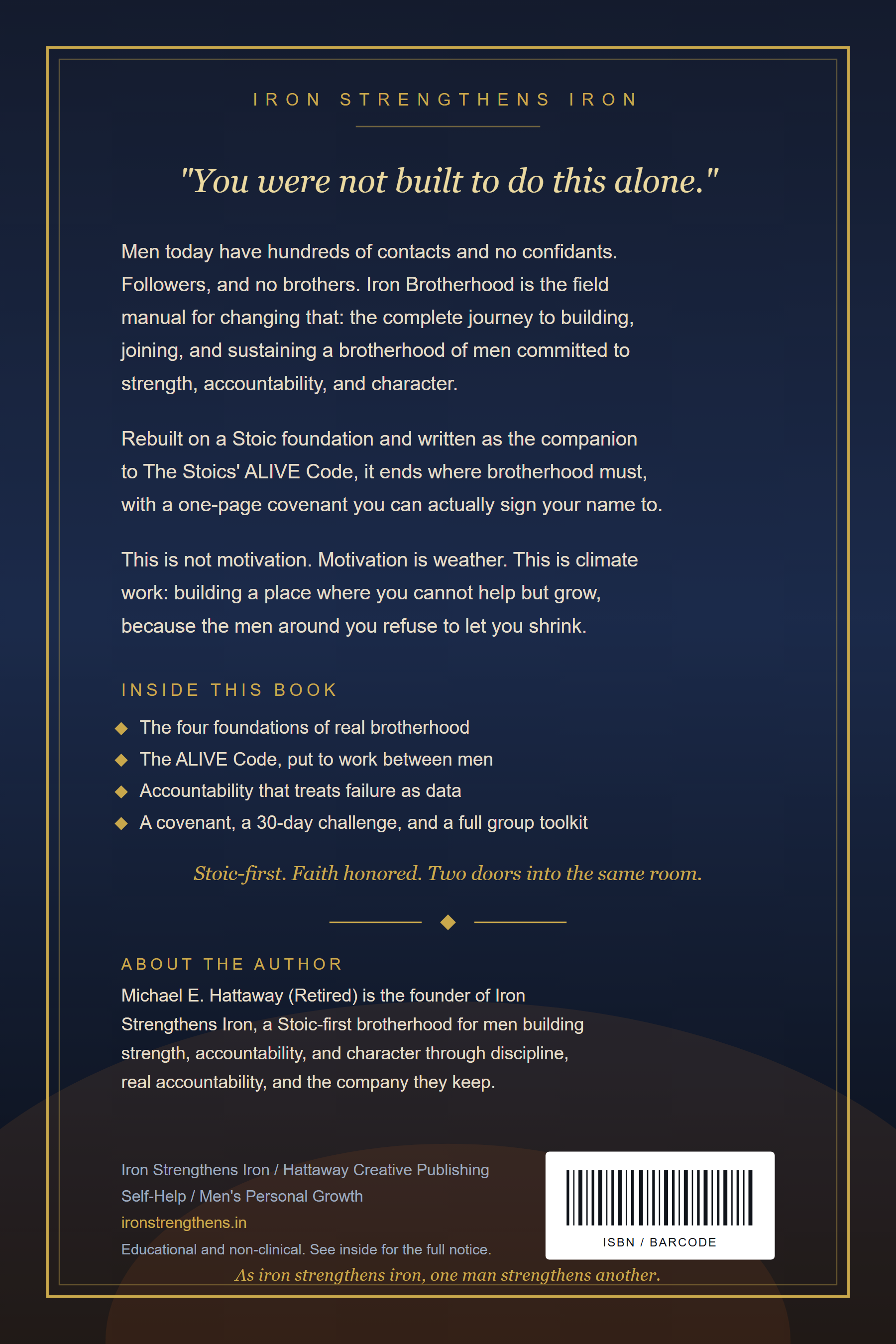
As Iron Strengthens Iron, One Man Strengthens Another.